
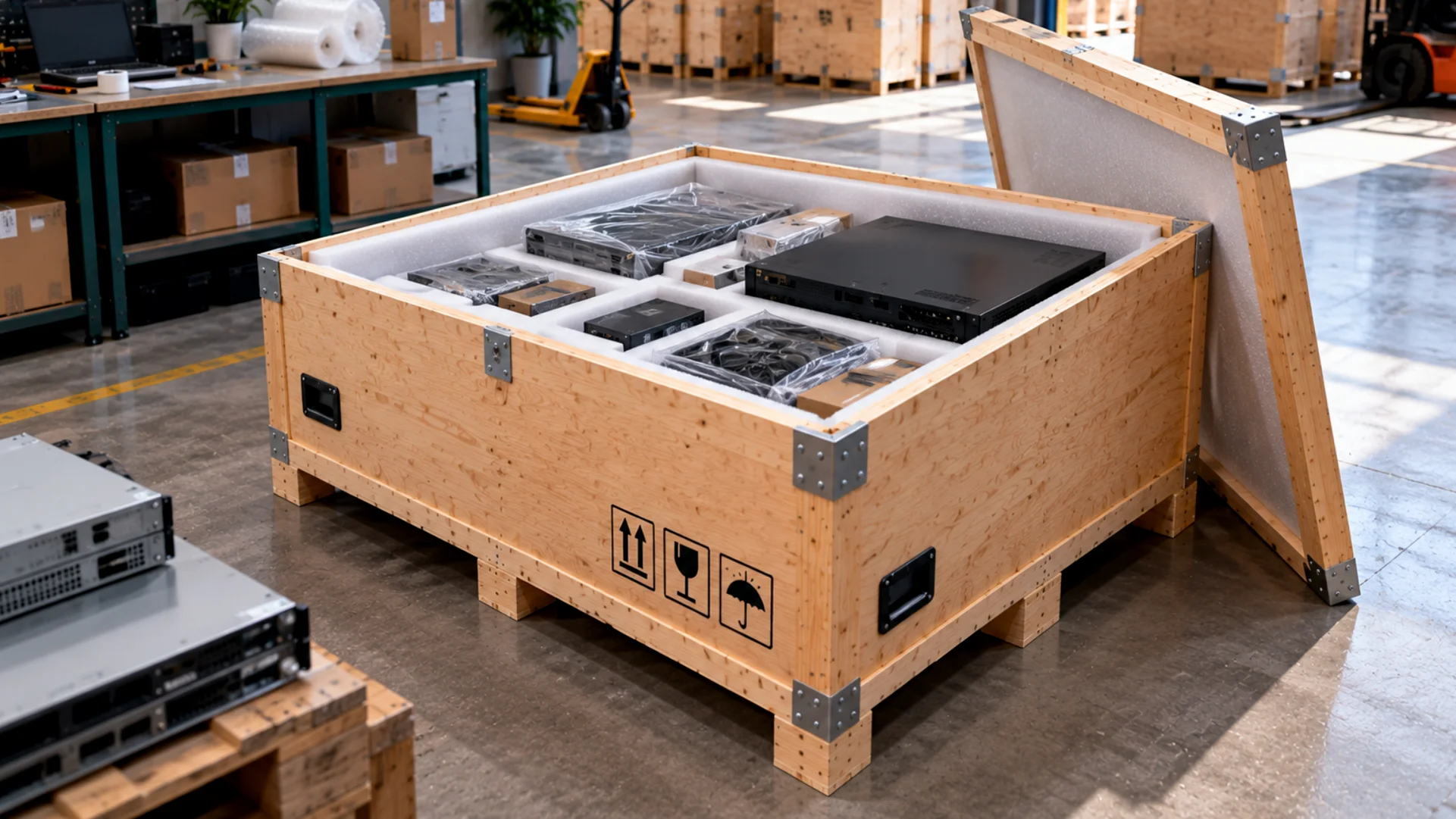
Packing a machine is a different problem from packing a pallet load. A pallet carries a distributed weight that sits flat. A machine concentrates several hundred kilograms onto a few small feet, arrives with its centre of gravity nowhere near the middle, and has to survive being lifted, trucked, craned and possibly shipped.
This guide sets out how to specify a heavy duty wooden crate for machinery properly — the parts of the crate, how to handle point loads, what clearance to allow, and the marking and treatment requirements. It is written by a machinery packing box manufacturer in Greater Noida who builds these to drawing.
Start here, because everything else follows from it. A 900 kg machine standing on four 80 mm feet is not a 900 kg distributed load — it is four concentrated loads of 225 kg each, applied to four small patches of the crate base. A base that would comfortably carry 1,500 kg spread evenly can fail under that.
The fix is to spread the load before it reaches the base boards, using a load-bearing skid directly under each foot, or a steel or timber spreader plate. Tell your packer where the feet are, not just what the machine weighs.
|
Part |
Function |
What to specify |
|
Skid / runner |
Raises the crate for forklift entry and carries the load path |
Section size, number of skids, entry width |
|
Base assembly |
Spreads the machine’s point loads |
Board thickness, cross-bearer spacing |
|
Frame |
Structural cage of the crate |
Timber section, corner construction |
|
Sheathing |
Closes the crate — plywood panels or timber slats |
Plywood thickness, or slat spacing for an open crate |
|
Cleats and gussets |
Stiffen panels and corners |
Where required by panel span |
|
Internal bracing |
Stops the machine moving inside the crate |
Blocking, chocks, bolt-down points |
|
Lifting provision |
Safe handling |
Forklift entry, sling points, marked centre of gravity |
An open slatted wooden crate is cheaper and lets the consignment be inspected without opening. A closed plywood box protects against weather, dust and pilferage. Choose on the transit, not on price alone.
Too tight and the machine contacts the panel at the first bump. Too loose and it moves, which is worse. As a working approach:
Two approaches, and the choice is driven by weight.
Bolting down is the right answer above roughly insert your threshold, commonly around 500 kg. The machine is bolted through its own mounting holes into a reinforced base. It cannot shift, and the load path is predictable.
Blocking and bracing suits lighter items. Timber chocks are fitted around the base and fastened to the crate so the item cannot slide or tip. It is faster and cheaper, but it depends entirely on the chocks being fitted properly — which is a workmanship question, not a materials question.
The figures below are indicative construction guidance. Your own tested values should replace them before publishing.
|
Gross weight |
Base construction |
Securing method |
Lifting |
|
Up to 250 kg |
spec |
Blocking and bracing |
Forklift from two sides |
|
250 – 750 kg |
spec |
Blocking, or bolt-down if delicate |
Forklift from four sides |
|
750 – 2,000 kg |
spec |
Bolted to reinforced base |
Forklift plus marked sling points |
|
Above 2,000 kg |
spec |
Bolted, with spreader plates |
Crane lift; CoG marked on all faces |
Where the item is stable and needs no enclosure, a heavy duty pallet with bolt-down provision is often sufficient and considerably cheaper than a full crate.
A crate that nobody can read is a crate that gets dropped. Standard handling symbols under ISO 780 — this way up, fragile, sling here, do not stack, keep dry — should be printed large and applied to at least two opposite faces. Add:
Solid timber packaging crossing an international border must be heat treated and marked under ISPM-15. Plywood sheathing is exempt, but the timber frame, skids and bracing are not. A plywood-sheathed crate on a treated frame is compliant and usually the most economical compliant option. The full requirement is set out in our ISPM-15 compliance guide.
Send us the drawing and we will come back with a construction proposal and a price.
|
Blue phrase in the text |
Link to |
|
wooden crate |
/products/wooden-crates/ |
|
plywood box |
/products/wooden-boxes/plywood-box/ |
|
heavy duty pallet |
/products/wooden-pallets/heavy-duty-pallet/ |
|
ISPM-15 compliance guide |
/products/ispm-15-heat-treated-pallets/ |
|
Send us the drawing |
/get-quote/ |
|
(add in intro) |
/industries/engineering/ |
|
(add near weight table) |
/products/wooden-boxes/heavy-duty-box |