
If you run despatch at a component plant, the pallet is rarely the thing you want to think about. It becomes a problem only twice: when it fails in transit, and when the one you ordered does not fit the racking, the trolley or the container. Both are specification problems, and both are avoidable at the enquiry stage.
This guide covers how to specify wooden pallets for the automotive industry — what entry type to ask for, how to read a load rating, when a returnable pallet pays for itself, and the details that go wrong most often. It is written from the manufacturing side, by a pallet manufacturer for auto components supplying Tier-1 and ancillary units across Delhi NCR.
Three things make component despatch different from general warehousing. First, the weight range is enormous — the same plant might ship a pallet of plastic clips at 80 kg and a pallet of castings at 1,200 kg, and a single pallet specification cannot serve both. Second, a large share of the movement is a closed loop between your plant and an OEM, which changes the economics entirely. Third, the schedule is unforgiving: a pallet shortage on a Thursday is a line stoppage on a Friday.
The practical consequence is that most component plants end up needing three or four pallet specifications rather than one, and a supplier who can hold those specifications on record and repeat them reliably.
This is the first decision, and it is driven by how the pallet is handled rather than by what sits on it. A four way pallet can be picked from all four sides, which matters when despatch is congested, when pallets are stored close together, or when a pallet truck approaches from whichever side is free. A two way pallet costs less and is stronger along its bearer axis, which suits a fixed handling route.
|
Factor |
Two way entry |
Four way entry |
|
Forklift access |
Two opposite sides only |
All four sides |
|
Relative cost |
Lower |
Higher — more cutting and assembly |
|
Congested despatch bay |
Slower, needs repositioning |
Faster turnaround |
|
Beam racking |
Generally suitable along bearer axis |
Suitable; confirm bottom deck layout |
|
Best suited to |
Fixed route, floor stacking, one-way shipment |
Mixed handling, tight bays, container stuffing |
|
Typical use at a component plant |
Outbound to a single known destination |
Line-side and internal movement |
Rule of thumb: if more than one type of handling equipment touches the pallet, specify four way. The cost difference is recovered in handling time within a few months on a high-turn line.
A single number on a quotation is not a load rating. There are three, and confusing them is the most common cause of a pallet failing in service.
|
Rating |
What it means |
Where it matters |
|
Static load |
Weight the pallet carries at rest on a flat floor, including pallets stacked on top of it |
Block stacking in the warehouse |
|
Dynamic load |
Weight the pallet carries while being lifted and moved |
Forklift and pallet truck handling |
|
Racking load |
Weight the pallet carries when supported only at its edges on beams |
Beam racking — always the lowest of the three |
Racking load is the figure that catches people out. A pallet rated comfortably for 1,500 kg on the floor may deflect unacceptably when supported only on two beams. If any part of your despatch goes into beam racking, quote the racking figure in your enquiry, not the static one.
At HH Enterprises our standard heavy duty wooden pallet construction is rated at static / dynamic / racking figures in kg — insert your tested values for a size pallet. Heavier requirements are met by increasing deck thickness and bearer count — see heavy duty pallets for the construction options.
Pine sections are lighter and cheaper and suit most component work. A plywood deck gives a flat continuous surface, which matters when you are stacking cartons, when small parts could fall between slats, or when the load is wrapped in film that a slat edge could tear. Mixed construction — a plywood pallet deck on pine bearers — is common and is usually the right answer for cartoned components.
If a pallet travels to an OEM 30 km away and comes back, you are not buying packaging, you are buying an asset. The arithmetic changes completely. A one-way pallet at a low price that survives four trips is more expensive per trip than a reinforced pallet at a higher price that survives twenty-five.
Work it out before you buy:
For closed-loop movement we normally recommend a reinforced four way construction with a thicker top deck and additional bearers. For genuinely one-way export despatch, a lighter specification with ISPM-15 treatment is usually the better economics — covered in our guide to ISPM-15 export packaging.
The most common sizing mistake in component despatch is starting from the container or truck dimension and working inwards. Start from the bin, tray or carton that actually sits on the pallet. Get the footprint of one unit, work out the pattern, and let the pallet size follow. A pallet that is 60 mm oversize means an overhang that will be crushed in transit; 60 mm undersize means an unsupported carton edge.
Also confirm the two dimensions people forget: the height clearance in your racking including the pallet itself, and the diagonal, if the load has to go through a doorway on a trolley.
Our regular automotive work covers component despatch to OEM plants, line-side storage bases, returnable crate bottoms, and heavy boxes for castings and forgings. Buyers in this segment include name the two or three automotive clients whose written permission you have — otherwise write "Tier-1 component manufacturers and forging units in the Noida–Greater Noida belt".
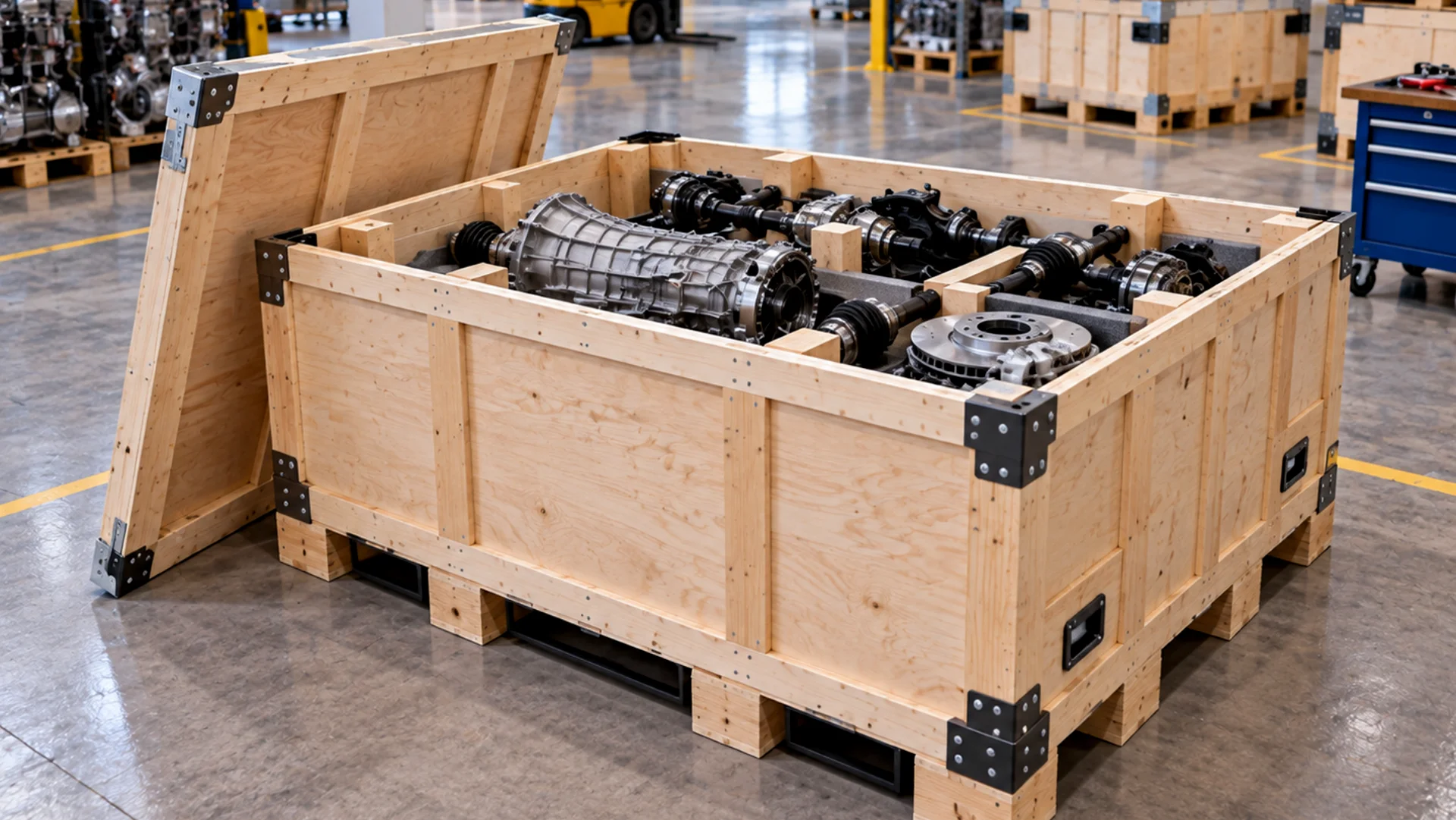
Where the part is fragile or awkward, a pallet alone is not the answer and we build a wooden crate around it instead.
That is usually enough for a quotation the same working day. If the part is unusual, a photograph tells us more than a description. Send us your requirement and we will come back with a specification and a price.
|
Blue phrase in the text |
Link to |
|
four way pallet |
/products/wooden-pallets/four-way-pallet/ |
|
two way pallet |
/products/wooden-pallets/two-way-pallet/ |
|
heavy duty pallets |
/products/wooden-pallets/heavy-duty-pallet/ |
|
plywood pallet |
/products/wooden-pallets/plywood-pallet/ |
|
ISPM-15 export packaging |
/products/ispm-15-heat-treated-pallets/ |
|
wooden crate |
/products/wooden-crates/ |
|
Send us your requirement |
/get-quote/ |
|
(add in intro) |
/industries/automotive/ |