
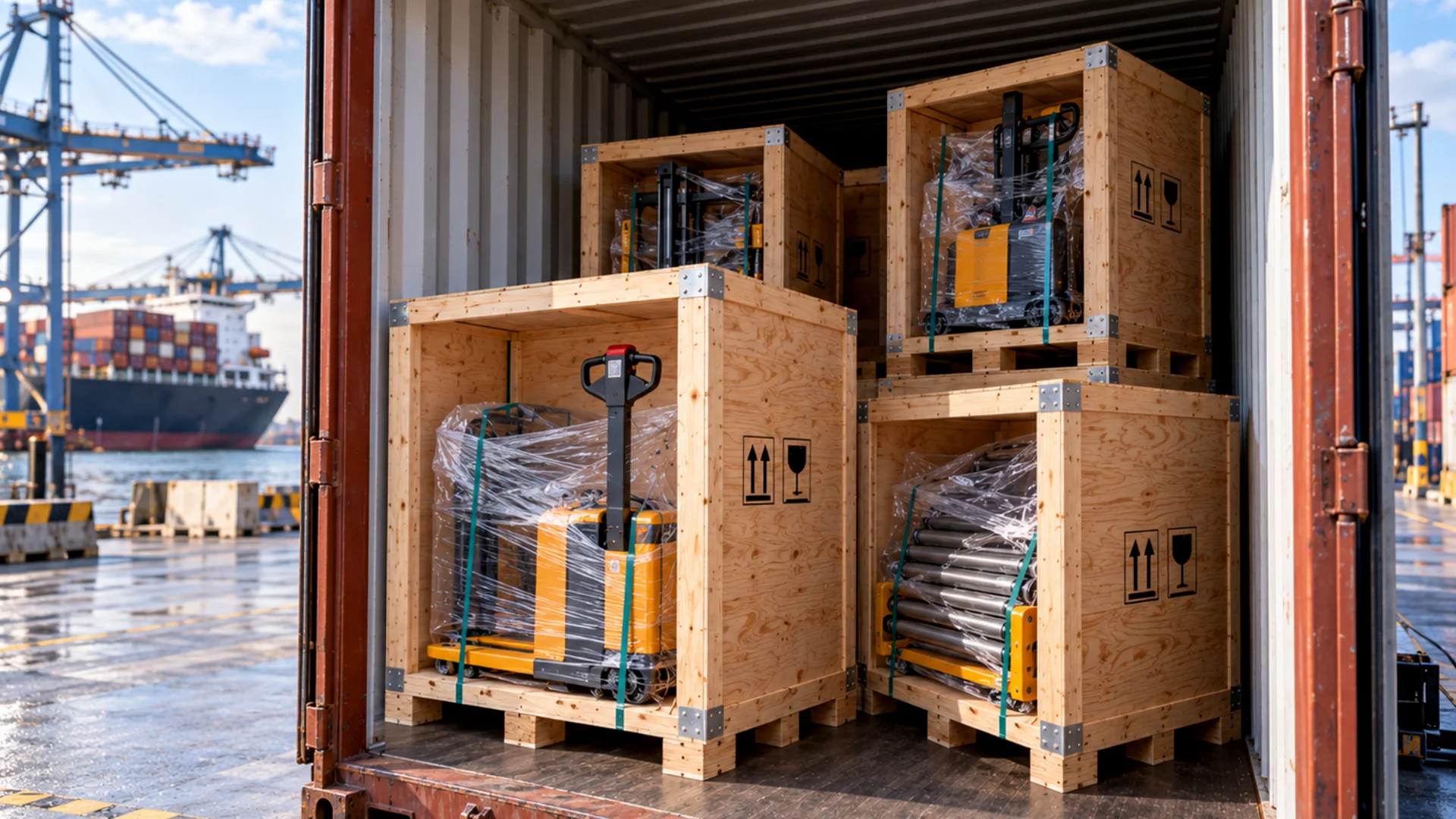
Every year Indian consignments are held, fumigated at the exporter’s cost, or refused at a foreign port for one avoidable reason — the timber under the cargo was not compliant. The goods were fine. The pallet was not.
This checklist sets out what ISPM-15 certified pallets actually require, how to read the mark, what is exempt, and where compliance most often breaks down. If you export on timber, this is the standard you cannot delegate and forget.
ISPM-15 is an international phytosanitary standard issued under the International Plant Protection Convention. Its purpose is to stop timber pests travelling between countries inside packaging material. It requires that qualifying wood be treated and marked before it crosses a border, and it is implemented nationally by each country’s National Plant Protection Organisation.
It applies to solid wood packaging above 6 mm in thickness used to support, protect or carry cargo — pallets, crates, boxes, dunnage, drums and cable drums. It says nothing about how well your load is secured; a compliant pallet with a badly strapped load still arrives damaged.
|
Material |
Status |
Note |
|
Solid timber over 6 mm |
In scope |
Must be treated and marked |
|
Plywood |
Exempt |
Manufacturing heat and adhesive already eliminate pest risk |
|
OSB, particle board, MDF |
Exempt |
Same reasoning as plywood |
|
Veneer and wood under 6 mm |
Exempt |
Below the thickness threshold |
|
Plastic and metal packaging |
Out of scope |
No treatment or marking required |
The practical consequence: a plywood box built on a heat-treated solid timber frame is fully compliant, and usually cheaper than an all-solid-timber box of the same size. The exemption applies to the panels, never to the frame, skids or bracing.
Be aware of the reverse trap as well. A pallet built from treated boards loses its compliance if even one untreated block or repair piece is fitted. Mixed construction is treated as non-compliant in full.
|
Code |
Treatment |
Requirement |
Status |
|
HT |
Heat treatment |
Timber core held at a minimum of 56°C for at least 30 minutes |
Accepted everywhere; the practical default |
|
DH |
Dielectric heating |
Microwave or radio-frequency heating to specification |
Accepted; less common in India |
|
MB |
Methyl bromide fumigation |
Chemical fumigation |
Restricted or banned in several markets, including the EU. Avoid. |
Since the 2009 revision, timber must also be debarked before treatment, whichever treatment is used. Small residual patches of bark are tolerated within defined limits, but the debarking step itself is not optional.
The IPPC mark is what an inspector at the destination port looks for. It carries four elements:
The mark must be legible, permanent and not transferable, applied to at least two opposite sides of the unit, and must not be red or orange. Hand-drawn or altered marks are rejected outright.
This is the part exporters most often get wrong. Only a facility registered with the National Plant Protection Organisation may apply the IPPC mark. Buying heat-treated timber does not entitle you, or your packer, to stamp it. In India the registration is issued through the plant quarantine authority and appears on the stamp in a format such as IN-000/HT.
When you appoint a packaging supplier, ask for the registration number in writing and check that the number on the stamp matches it. HH Enterprises heat treats and marks export packaging under registration TODO-ISPM — insert your DPPQS registration number, or state clearly that treatment is carried out by a named registered facility on your behalf.
If treatment is carried out by a registered third party rather than in-house, say so plainly. It is a completely normal arrangement, and stating it accurately is far safer than an unqualified claim that cannot be evidenced during a vendor audit.
|
# |
Check |
Confirmed by |
|
1 |
All solid timber in the consignment is treated and marked |
Packing supervisor |
|
2 |
Stamp visible on at least two opposite sides of every unit |
Packing supervisor |
|
3 |
Registration number on the stamp matches your supplier’s documentation |
Purchase / logistics |
|
4 |
Dunnage inside the container is treated and marked |
Loading supervisor |
|
5 |
No untreated repair pieces fitted after treatment |
Quality |
|
6 |
Treatment record filed against the consignment |
Documentation |
|
7 |
Destination country checked for additional requirements |
Logistics |
|
8 |
Load secured independently of compliance — strapping, film, bracing |
Packing supervisor |
If you ship on timber every week, three habits remove most of the risk. Buy from one registered source so there is a single registration number to verify. Keep treatment records filed against consignment numbers rather than loose. And photograph the stamp on a loaded unit before the container doors close — it costs nothing and settles any later dispute.
For European destinations, euro pallets in the 1200 × 800 footprint simplify handling at the far end. For high-value or awkward consignments, a treated wooden crate gives better protection than a pallet and wrap.
Ask us for a compliant packing specification and we will quote against your consignment and destination.
|
Blue phrase in the text |
Link to |
|
plywood box |
/products/wooden-boxes/plywood-box/ |
|
euro pallets |
/products/wooden-pallets/euro-pallet/ |
|
wooden crate |
/products/wooden-crates/ |
|
Ask us for a compliant packing specification |
/get-quote/ |
|
(add in intro) |
/products/ispm-15-heat-treated-pallets/ |
|
(add in intro) |
/industries/export-houses/ |